

Opinion & investing ideas
jeudi 4 août 2011

mercredi 3 août 2011
Intel et la Chine

Intel Capital, the venture-capital arm of the world’s biggest chipmaker, said it may boost its investments by more than 50 percent this year, adding deals in overseas markets including China.
The investment arm of Intel Corp. (INTC) plans to invest about $500 million globally in 2011, President Arvind Sodhani said at a briefing in Beijing today. Intel Capital invested $327 million last year, according to its website.
Intel Capital is stepping up its search for technology companies in China, the world’s fastest-growing major economy, where the firm has made six investments this year. That number may increase to 12, Sodhani said today.
“We are very aggressive and very focused on china, and we’ll continue to find innovative companies and invest in them,” Sodhani said.
Intel Capital invested a combined $22 million in three Chinese technology companies, 6DXchange Inc., Beijing JoySee Technology Co. and Shanghai BOCOM Intelligent Network Technologies Co., it said in a statement today.
The investment arm of Intel Corp. (INTC) plans to invest about $500 million globally in 2011, President Arvind Sodhani said at a briefing in Beijing today. Intel Capital invested $327 million last year, according to its website.
Intel Capital is stepping up its search for technology companies in China, the world’s fastest-growing major economy, where the firm has made six investments this year. That number may increase to 12, Sodhani said today.
“We are very aggressive and very focused on china, and we’ll continue to find innovative companies and invest in them,” Sodhani said.
Intel Capital invested a combined $22 million in three Chinese technology companies, 6DXchange Inc., Beijing JoySee Technology Co. and Shanghai BOCOM Intelligent Network Technologies Co., it said in a statement today.
Smartphone maker Research in Motion Ltd. has released five new phones this morning, including one, gasp, that does not have a keyboard. While shares are getting a bounce pre-market, this announcement is still too little, too late.
Any idea that RIM may have of competing with Apple Inc for hardware dominance or with Google Inc for operating system dominance is surely wishful thinking. The coalition between Microsoft Corp and Nokia Corp also stands a chance of putting RIM further on the back burner later this year.
RIM’s hardware aspirations depend on volume, not profit margin. Apple’s iPhones currently produce nearly $300/phone in profit. Blackberries produce about $75/phone, barely ahead of third-place phone maker HTC Corp. In software platform distribution, RIM trails Google’s Android operating system, the rapidly vanishing Symbian OS from Nokia, and Apple’s iOS.
Any idea that RIM may have of competing with Apple Inc for hardware dominance or with Google Inc for operating system dominance is surely wishful thinking. The coalition between Microsoft Corp and Nokia Corp also stands a chance of putting RIM further on the back burner later this year.
RIM’s hardware aspirations depend on volume, not profit margin. Apple’s iPhones currently produce nearly $300/phone in profit. Blackberries produce about $75/phone, barely ahead of third-place phone maker HTC Corp. In software platform distribution, RIM trails Google’s Android operating system, the rapidly vanishing Symbian OS from Nokia, and Apple’s iOS.
mardi 2 août 2011
600 millions de fois ...oui ! à Apple

As if you needed more reasons to go long Apple (NASDAQ: AAPL).
According to a report from Forbes, China Mobile (NYSE: CHL) may be indeed getting the Apple iPhone, at least if you believe Chinese newspapers.
The Forbes report says that the world's largest cell phone company and the world's most popular phone have agreed to join forces, and the iPhone will run on China Mobile's CDMA network.
With over 600 million subscribers, China Mobile presents an opportunity for Apple that nowhere else in the world provides.
There were pictures out late in July that showed acting CEO Tim Cook meeting with China Mobile executives, presumably to discuss bringing the iconic phone to China Mobile, legally. According to a report from AppleInsider, there were already 4 million iPhones on the China Mobile network, but they are all illegal, as the two companies did not have a deal: until now.
When news hit that Cook was meeting with China Mobile execs, Brian White with Ticonderoga Securities was very positive on the smartphone market in China and what it meant for Apple. He said that the the high end phone market for smartphones in China is 100-125 million subscribers, which would translate to potentially $70 billion in revenues. "The numbers speak for themselves," he said in a note to investors. "For example, Apple generated approximately $5 billion in revenue from Greater China during (the first half of fiscal 2011) or 10% of sales compared to $3 billion for all of (fiscal year 2010)."
"Traveling to China is a major undertaking and we doubt Tim Cook would be visiting China Mobile unless the two companies were getting close to a partnership," White said. "Essentially, we believe the data points in recent months foreshadow an accelerated relationship between the two companies and we are inclined to believe that an announcement is imminent over the next several months."
Supposedly, the two companies will make available iPhone as early as October and as late as early 2012.
After Apple reported a blowout quarter that not even the highest estimates on Wall Street predicted, some thought that this was going to be the next catalyst for Apple going forward.
With over $76 billion in cash, and short-term securities, Apple has more cash currently than the U.S. Treasury (I know, the joke is old, but it puts things into perspective), and is probably more dominant and definitely more relevant in America's eyes.
China is going to be a huge market for Apple going forward, as revenue in the country rose six-fold from the year ago quarter, and this deal with China Mobile will only make China that much more important. Predominantly, the majority of Apple's revenues have been generated in the U.S. Going forward, it will likely be more even around the world, with Asia seeing huge growth as consumers clamor for the iPhone.
Apple just continues everyday to give investors reasons to buy the stock. $76 billion in cash. A 13 forward earnings multiple. Explosive revenue growth. The greatest tech innovator of our time (Steve Jobs).
Now it just gave you another 600 million reasons to buy it. Not bad for a company started out of a garage in California.
According to a report from Forbes, China Mobile (NYSE: CHL) may be indeed getting the Apple iPhone, at least if you believe Chinese newspapers.
The Forbes report says that the world's largest cell phone company and the world's most popular phone have agreed to join forces, and the iPhone will run on China Mobile's CDMA network.
With over 600 million subscribers, China Mobile presents an opportunity for Apple that nowhere else in the world provides.
There were pictures out late in July that showed acting CEO Tim Cook meeting with China Mobile executives, presumably to discuss bringing the iconic phone to China Mobile, legally. According to a report from AppleInsider, there were already 4 million iPhones on the China Mobile network, but they are all illegal, as the two companies did not have a deal: until now.
When news hit that Cook was meeting with China Mobile execs, Brian White with Ticonderoga Securities was very positive on the smartphone market in China and what it meant for Apple. He said that the the high end phone market for smartphones in China is 100-125 million subscribers, which would translate to potentially $70 billion in revenues. "The numbers speak for themselves," he said in a note to investors. "For example, Apple generated approximately $5 billion in revenue from Greater China during (the first half of fiscal 2011) or 10% of sales compared to $3 billion for all of (fiscal year 2010)."
"Traveling to China is a major undertaking and we doubt Tim Cook would be visiting China Mobile unless the two companies were getting close to a partnership," White said. "Essentially, we believe the data points in recent months foreshadow an accelerated relationship between the two companies and we are inclined to believe that an announcement is imminent over the next several months."
Supposedly, the two companies will make available iPhone as early as October and as late as early 2012.
After Apple reported a blowout quarter that not even the highest estimates on Wall Street predicted, some thought that this was going to be the next catalyst for Apple going forward.
With over $76 billion in cash, and short-term securities, Apple has more cash currently than the U.S. Treasury (I know, the joke is old, but it puts things into perspective), and is probably more dominant and definitely more relevant in America's eyes.
China is going to be a huge market for Apple going forward, as revenue in the country rose six-fold from the year ago quarter, and this deal with China Mobile will only make China that much more important. Predominantly, the majority of Apple's revenues have been generated in the U.S. Going forward, it will likely be more even around the world, with Asia seeing huge growth as consumers clamor for the iPhone.
Apple just continues everyday to give investors reasons to buy the stock. $76 billion in cash. A 13 forward earnings multiple. Explosive revenue growth. The greatest tech innovator of our time (Steve Jobs).
Now it just gave you another 600 million reasons to buy it. Not bad for a company started out of a garage in California.
gap up
Jul-20-2011
378.65 to 386....le stock est un buy quand le gap va se fermer...mon humble avis
Jul-20-2011
378.65 to 386....le stock est un buy quand le gap va se fermer...mon humble avis

Foxconn, qui fabrique des pièces électroniques pour Apple, Sony, Nokia et autres, remplace graduellement ses employés par des robots. D'ici trois ans, l'entreprise taïwanaise comptera sur 1 million d'automates, ce qui lui permettra de diminuer ses coûts de main-d'oeuvre.Le géant de l'électronique fait présentement appel à 10 000 robots. Ce nombre grimpera à 300 000 l'an prochain et atteindra le million dans trois ans. Pour l'instant, les robots n'effectueront que des tâches simples, telles la peinture, la soudure ou l'assemblage. Les 1,2 million d'employés de Foxconn ne seront donc pas tous remplacés, quoique ces étapes de la chaîne de montage représentent une part importante de ce qui est accompli par l'entreprise.Rappelons que plusieurs suicides d'employés de Foxconn ont été rapportés dernièrement. On indique que des conditions de travail difficiles pourraient être à l'origine de ceux-ci.
lundi 1 août 2011
MMI

Motorola Mobility, which split from parent company Motorola in January, posted a quarterly net loss on Thursday but said it expects to be profitable for the full year.
The US handset and tablet computer maker reported a net loss of $56 million for the second quarter, compared to a net profit of $80 million in the same quarter a year ago.
Revenue was up 28 percent over a year ago at $3.3 billion, slightly better than the forecasts of Wall Street analysts. Earnings per share of nine cents were also better than the six cents per share expected by analysts.
Motorola Mobility said it shipped 11 million mobile devices during the quarter, including 4.4 million smartphones and 440,000 Xoom tablets.
The Android-powered Xoom, Motorola's answer to the iPad, has received good reviews but has not managed to match the success of the hot-selling Apple device. Apple sold 9.25 million iPads last quarter.
Motorola Mobility said it expects to ship between 21 million and 23 million mobile devices this year, including between 1.3 million and 1.5 million tablets.
It said revenue from mobile devices rose 41 percent to $2.4 billion in the quarter, with Latin America and China driving the growth.
Revenue rose two percent at Motorola Mobility's home division in the quarter to $907 million.
"With a focus on profitable growth and delivering differentiated LTE smartphones and tablets, we expect to achieve profitability in Mobile Devices in the fourth quarter and for the full year," Motorola Mobility chairman and chief executive Sanjay Jha said in a statement.
CVX

Integrated oil giant Chevron Corporation on Monday saw its price target and earnings estimates raised by analysts at Barclays Capital.
The firm said it boosted its price target for CVX to $135, suggesting a nearly 30% upside to the stock’s Friday closing ...
The firm said it boosted its price target for CVX to $135, suggesting a nearly 30% upside to the stock’s Friday closing ...
Ce qui est surprenant de ce "upgrade" c'est que le stock a une résistance énorme à 110$...
et n'a jamais été plus haut de toute son histoire.
dimanche 31 juillet 2011

The juggernaut that is Apple (NASDAQ: AAPL) iPhone sales grows more powerful each day. New data show that Apple thrashed its smartphone competitors in the second quarter and may have become the largest smartphone vendor in the world. Figures from research firms IDC and Strategy Analytics on activity from April to June vary slightly, but the theme is the same. Apple’s competitors have not been able to launch products that were met with any significant success.
Strategic Analytics figures show that “Apple overtook Nokia and Samsung to become the world’s number one smartphone vendor by volume for the first time in history.” During the same period, overall worldwide smartphone sales grew 76% year-over-year to 110 million units. The cycle in which people replace “dumb” handsets with ones that can work on 3G networks, play multimedia products and games, and send large files is now well underway.
Apple’s success was nearly matched by the No.2 handset company in the world — Samsung. The Korean company’s global market share in the smartphone business was 17.5% compared to Apple’s 18.5% last quarter. Nokia (NYSE: NOK) continued its spiral down as its share dropped to 16.7%. It is worth remembering that Nokia was the top smartphone manufacturer in the world last year, and just three years ago sold nearly one in four of all handsets in the world.
Is there a lesson here among all the new data? Probably not. The numbers show what almost everyone in the smartphone industry knew already. The iPhone’s advance has been relentless for the three years since it was launched. It has only recently begun to get wide distribution in China, the world’s largest wireless market.
Skeptics about the iPhone’s future use three arguments for why the product’s sales will eventually falter. The first is that new models like the iPhone 5 will not have enough new features to lure buyers to replace older models or switch from other manufacturers. The second is that Android-powered handsets have gained ground because of popular features that were added to the Google operating system by companies that compete with Apple. The third is that any one company can only have so much market share before it reaches a saturation level.
None of these potential drawbacks apply to Apple for now. There is precedent in other markets and at other times for a product to hold 50% or more share in its sector. The Amazon (NASDAQ: AMZN) Kindle is one example. The Apple iPad is another. The iPhone’s market share is still less than 20%. The popularity of the product has not wavered. The iPhone’s piece of the market could still double....
Strategic Analytics figures show that “Apple overtook Nokia and Samsung to become the world’s number one smartphone vendor by volume for the first time in history.” During the same period, overall worldwide smartphone sales grew 76% year-over-year to 110 million units. The cycle in which people replace “dumb” handsets with ones that can work on 3G networks, play multimedia products and games, and send large files is now well underway.
Apple’s success was nearly matched by the No.2 handset company in the world — Samsung. The Korean company’s global market share in the smartphone business was 17.5% compared to Apple’s 18.5% last quarter. Nokia (NYSE: NOK) continued its spiral down as its share dropped to 16.7%. It is worth remembering that Nokia was the top smartphone manufacturer in the world last year, and just three years ago sold nearly one in four of all handsets in the world.
Is there a lesson here among all the new data? Probably not. The numbers show what almost everyone in the smartphone industry knew already. The iPhone’s advance has been relentless for the three years since it was launched. It has only recently begun to get wide distribution in China, the world’s largest wireless market.
Skeptics about the iPhone’s future use three arguments for why the product’s sales will eventually falter. The first is that new models like the iPhone 5 will not have enough new features to lure buyers to replace older models or switch from other manufacturers. The second is that Android-powered handsets have gained ground because of popular features that were added to the Google operating system by companies that compete with Apple. The third is that any one company can only have so much market share before it reaches a saturation level.
None of these potential drawbacks apply to Apple for now. There is precedent in other markets and at other times for a product to hold 50% or more share in its sector. The Amazon (NASDAQ: AMZN) Kindle is one example. The Apple iPad is another. The iPhone’s market share is still less than 20%. The popularity of the product has not wavered. The iPhone’s piece of the market could still double....
vendredi 29 juillet 2011

Verizon Wireless is owned 55% by Verizon (NYSE: VZ) and 45% by UK-based Vodafone (NYSE: VOD). Yesterday, the cellular service provider said it would pay a dividend of $10 billion next year. The size of the figure is extraordinary. It raises the question of what Verizon will do with its $5.5 billion, and the phone company’s shareholders should be particularly interested.
The existence of Verizon Wireless is due to a strange turn of events nearly a decade ago. Vodafone was a burgeoning cellular provider in America. Verizon was in the midst of early competition with AT&T (NYSE: T), Sprint and Nextel before they merged, as well as a slew of smaller companies. All were in a fight for business in the U.S. market, which was still relatively immature, at least compared to now.
Verizon and Vodafone merged their cellular operations for many of the same reasons that AT&T is about to buy T-Mobile. It is often cheaper to buy customers by the millions than to try to fight for them one-by-one.
Verizon has run up a long list of expenses in the last four years. The largest is led by its $20 billion plus investment to build a fiber-to-the-home competitor to cable TV and broadband services. Subscriptions to the product have grown more slowly than Verizon supposed. The company’s $5.5 billion payout from Verizon Wireless could be used to reduce some of the debt incurred by the costs to create that infrastructure.
Verizon could also turn that money back to its shareholders. The company already has a dividend payout with a current yield of 5.2% — high by the standards of other huge American public companies. Verizon’s stock holders can complain the dividend is not enough. The telecom’s stock is up only 12% in the last two years while the S&P is 33% higher.
The existence of Verizon Wireless is due to a strange turn of events nearly a decade ago. Vodafone was a burgeoning cellular provider in America. Verizon was in the midst of early competition with AT&T (NYSE: T), Sprint and Nextel before they merged, as well as a slew of smaller companies. All were in a fight for business in the U.S. market, which was still relatively immature, at least compared to now.
Verizon and Vodafone merged their cellular operations for many of the same reasons that AT&T is about to buy T-Mobile. It is often cheaper to buy customers by the millions than to try to fight for them one-by-one.
Verizon has run up a long list of expenses in the last four years. The largest is led by its $20 billion plus investment to build a fiber-to-the-home competitor to cable TV and broadband services. Subscriptions to the product have grown more slowly than Verizon supposed. The company’s $5.5 billion payout from Verizon Wireless could be used to reduce some of the debt incurred by the costs to create that infrastructure.
Verizon could also turn that money back to its shareholders. The company already has a dividend payout with a current yield of 5.2% — high by the standards of other huge American public companies. Verizon’s stock holders can complain the dividend is not enough. The telecom’s stock is up only 12% in the last two years while the S&P is 33% higher.
jeudi 28 juillet 2011
TRI.nyse TRI.to

Le groupe d'information financières Thomson reuters a fait état aujourd'hui d'une croissance molle tout en publiant une marge d'exploitation supérieure aux attentes, ce qui a rassuré les marchés.
Les résultats du deuxième trimestre surviennent dans la foulée d'un remaniement hiérarchique, qui a vu le directeur général Devin Wenig et cinq autres cadres quitter l'entreprise.
Le pôle Marchés est désormais placé sous la responsabilité directe du grand boss, Thomas Glocer, qui prévoit un plan sur un an pour en accélérer la croissance.
Le chiffre d'affaires de cette division a augmenté de 1% sur un an à taux de changes constants, contre un gain de 2% au premier trimestre.
Le chiffre d'affaires global et le bénéfice par action sont conformes aux niveaux annoncés la semaine dernière par le groupe, soit 3,2 milliards de dollars.
Un grand nombre des clients de Thomson Reuters n'ont pas encore pleinement surmonté la crise financière, et ont réduit leurs effectifs et leurs dépenses.
Cette tendance, couplée aux difficultés de lancement de sa nouvelle plate-forme Eikon, nuit aux ventes de ce nouveau système qui vise à unifier sur la même plate-forme plusieurs dizaines de produits différents. http://www.zonebourse.com/THOMSON-REUTERS-CORP-14638/actualite/THOMSON-REUTERS-CORP-DEVOILE-SA-PLATE-FORME-NOUVELLE-GENERATION-13455729/?imprimer=1
Le groupe a indiqué avoir vendu plus de 28.000 plateformes Eikon depuis le lancement en septembre 2010, dont 3.500 à de nouveaux clients. Cela signifie que sur les quelque 500.000 abonnés des marchés financiers, seuls 24.500 ont migré vers Eikon.
Les résultats du deuxième trimestre surviennent dans la foulée d'un remaniement hiérarchique, qui a vu le directeur général Devin Wenig et cinq autres cadres quitter l'entreprise.
Le pôle Marchés est désormais placé sous la responsabilité directe du grand boss, Thomas Glocer, qui prévoit un plan sur un an pour en accélérer la croissance.
Le chiffre d'affaires de cette division a augmenté de 1% sur un an à taux de changes constants, contre un gain de 2% au premier trimestre.
Le chiffre d'affaires global et le bénéfice par action sont conformes aux niveaux annoncés la semaine dernière par le groupe, soit 3,2 milliards de dollars.
Un grand nombre des clients de Thomson Reuters n'ont pas encore pleinement surmonté la crise financière, et ont réduit leurs effectifs et leurs dépenses.
Cette tendance, couplée aux difficultés de lancement de sa nouvelle plate-forme Eikon, nuit aux ventes de ce nouveau système qui vise à unifier sur la même plate-forme plusieurs dizaines de produits différents. http://www.zonebourse.com/THOMSON-REUTERS-CORP-14638/actualite/THOMSON-REUTERS-CORP-DEVOILE-SA-PLATE-FORME-NOUVELLE-GENERATION-13455729/?imprimer=1
Le groupe a indiqué avoir vendu plus de 28.000 plateformes Eikon depuis le lancement en septembre 2010, dont 3.500 à de nouveaux clients. Cela signifie que sur les quelque 500.000 abonnés des marchés financiers, seuls 24.500 ont migré vers Eikon.
Le plus gros actionnaire de la compagnie est la famille Canadienne Thomson.....
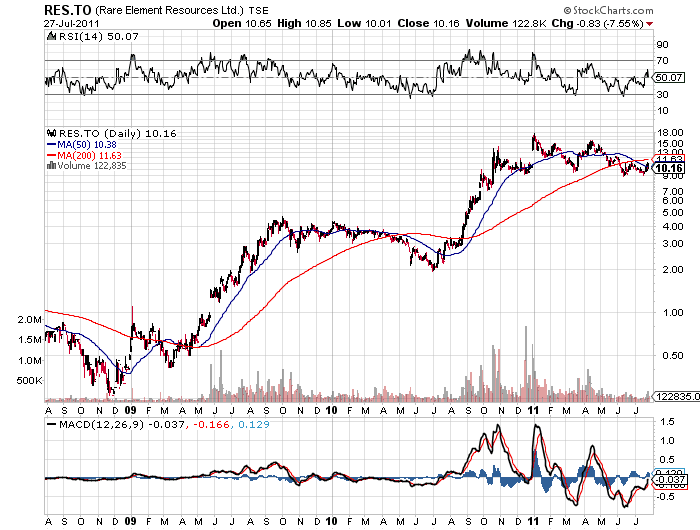
message de mon ami "boursicoteux"
cliquez pour agrandir
http://evenkeelmedia.com/rare-element-resources/
....quand la MA50 va repasser la MA200 ...
strong buy aggressive ! ...? bon ok! merci !"
http://evenkeelmedia.com/rare-element-resources/
....quand la MA50 va repasser la MA200 ...
strong buy aggressive ! ...? bon ok! merci !"
mercredi 27 juillet 2011
Aubaine ?

Les rumeurs du printemps dernier semblent se confirmer.....par A.Mullaly le CEO lui-même....
“we have a game plan. Liquidity is so important. We're continuing to improve the balance sheet and our goal is to have $10 billion on there. Then we can reinstate the dividend and share with the shareholders" le dernier div a été payé un gros 5 cents le 31 juillet 2006.... !!!
Le gap down de février 2011 doit être fermé...
...est-ce le temps d'un ré- IN ?...um...stand-buy for me...

Une nouvelle statistique de Entravel dit qu'en Chine
il y a 1,68 millions de chambres d'hotel louées chaques jours et la tendance s'accélère fortement...
WYN.nyse est en bonne position ...
Wyndham Hotel Group's position as the largest U.S.-based hotel company in China with 271 hotels representing over 42,000 rooms under the Wyndham Hotels and Resorts, Ramada, Howard Johnson, Days Inn and Super 8 brands. With the addition of this new signing, there are now 13 Wyndham branded properties currently open or under development in China.
AUTRES CHOIX
HMIN-HTHT-MAR-HOT-H ...et mon bébé SVN que j'ai acheté en IPO
mardi 26 juillet 2011
...café ? non...thé s.v.p

TEA.nyse IPO soon...Expected Date
Week of 7/25/11Price Range
$13 - $15 Shares Offered 7.1 millions
Week of 7/25/11Price Range
$13 - $15 Shares Offered 7.1 millions
lundi 25 juillet 2011
CARIBOU

cliquez pour agrandir.

Le "tim horton" Anglais Costa coffee va ouvrir d'ici la fin de cette année 100 magasins en Chine et 2500 jusqu'à 2017...Ironiquement ...Costa prend la place de certains Starbucks qui ont fermer due à la mauvaise planification du géant Américain...comme celui du terminal 3 de Beijing...
.....une guerre mondiale caféinée est en cours...
Il y a un stock "café" qui commence à déranger c'est CBOU.q http://www.cariboucoffee.com/ 20 millions d'actions sur le marché et pas une cenne de dette..!
Caribou Coffee Company, Inc. operates coffeehouses primarily in the United States. It offers premium coffee and espresso-based beverages, as well as specialty teas, baked goods, whole bean coffee, branded merchandise, and related products. As of January 3, 2010, the company had 534 coffeehouses, including 121 franchised coffeehouses located in Minnesota; Illinois; Ohio; Michigan; North Carolina; Georgia; Wisconsin; Virginia; Colorado; Maryland; Iowa; Washington, D.C.; North Dakota; Nebraska; Pennsylvania; Kansas; South Dakota; Missouri; Indiana; and Nevada, as well as in the international markets. It also sells premium whole bean and ground coffee to grocery stores, mass merchandisers, office coffee providers, airlines, hotels, sports and entertainment venues, college campuses, and online customers. The company was founded in 1992 and is headquartered in Minneapolis, Minnesota.
Il y a un stock "café" qui commence à déranger c'est CBOU.q http://www.cariboucoffee.com/ 20 millions d'actions sur le marché et pas une cenne de dette..!
Caribou Coffee Company, Inc. operates coffeehouses primarily in the United States. It offers premium coffee and espresso-based beverages, as well as specialty teas, baked goods, whole bean coffee, branded merchandise, and related products. As of January 3, 2010, the company had 534 coffeehouses, including 121 franchised coffeehouses located in Minnesota; Illinois; Ohio; Michigan; North Carolina; Georgia; Wisconsin; Virginia; Colorado; Maryland; Iowa; Washington, D.C.; North Dakota; Nebraska; Pennsylvania; Kansas; South Dakota; Missouri; Indiana; and Nevada, as well as in the international markets. It also sells premium whole bean and ground coffee to grocery stores, mass merchandisers, office coffee providers, airlines, hotels, sports and entertainment venues, college campuses, and online customers. The company was founded in 1992 and is headquartered in Minneapolis, Minnesota.
Samsung Electronics Co. maker of the Galaxy mobile phone, may have surpassed Nokia Oyj and Apple inc in smartphone sales for the first time on demand for devices that run on Android software, a research company said.
Samsung is estimated to have sold between 18 million and 21 million smartphones globally in the April-June quarter, compared with 16.2 million for Nokia and 20.3 million iPhones........bon ok ...mais la vrai question est "combien font-ils de profit par appareils ? et plus....http://www.idownloadblog.com/2011/07/01/ios-users-worth/
Samsung is estimated to have sold between 18 million and 21 million smartphones globally in the April-June quarter, compared with 16.2 million for Nokia and 20.3 million iPhones........bon ok ...mais la vrai question est "combien font-ils de profit par appareils ? et plus....http://www.idownloadblog.com/2011/07/01/ios-users-worth/
une autre chinoiserie...CADC

Vendredi dernier, le stock a monté EN FIN DE JOURNÉE de 9% pour le 2em meilleurs journée de transaction depuis le 24 février......2010 ! Je vais regarder cette compagnie attentivement cette semaine....
La MA200 baisse mais il y a peut-être du cash à faire court terme.
China Advanced Construction Materials Group, Inc., through its subsidiaries, produces and supplies ready mix concrete materials for the commercial, residential, and infrastructure developments primarily in the Republic of China.
L' Or a touché 1621$ un peu avant 20 hres hier soir pour descendre à 1614$ cette nuit....la bataille entre la maison blanche et le congrès énerve la planète "cash"...et les investisseurs ne semblent pas croire le "politicien" Obama...Le secrétaire américain au Trésor Timothy Geithner a estimé dimanche impensable que les Etats-Unis ne remplissent pas leurs obligations en matière de dette et s'est dit convaincu qu'un accord sur ce thème serait conclu....
vendredi 8 juillet 2011
Vacances
C'est le temps de prendre une pause dans ma vie de père de famille, de restaurateur, de collaborateur radio et de boursicoteur. Mon Amour et moi retournons voir nos amis les bernard l'hermite au 18 em parallèle...
De retour le lundi 25 juillet...
De retour le lundi 25 juillet...
Inscription à :
Articles (Atom)